This article was first published on Intellectual Asset Management on October 5, 2026.
To read the latest edition of the guide in which it appeared, please visit IAM - The Guide to Monetisation - Edition 3.
A successful in-house IP monetisation programme is a business operation built around a defined commercial opportunity, whether selling or licensing IP assets. This article discusses licensing specifically.
The starting point sounds simple, but in practice the decision to build such a programme raises several questions at the same time:
How much revenue can the monetisation programme make?
What exactly is being monetised?
Who would pay for it, and why?
What kind of investment is needed before revenues start to flow?
What organisation and capabilities are required?
How should the programme fit with the company’s existing businesses, including the risk of cannibalising current sales?
What is the potential impact of IP-rights exhaustion?
Who inside the company owns the overall vision and is responsible for making the programme happen?
I have worked with both patent licensing and technology licensing programmes, in established licensing businesses and companies starting monetisation activities for the first time. These two types of licensing have important differences, but there is also much they can teach each other. Looking at both patent and tech licensing helps to understand what an in-house monetisation programme actually requires.
For companies whose core business is something else than licensing, the starting point should be especially practical. Licensing may create a completely new revenue stream, support existing product sales, help build an ecosystem around the company’s technology or provide a return on earlier R&D investment. Sometimes the best solution is to build the capability internally. Sometimes it is to outsource part of the work, use a patent pool, work with an external monetisation partner or sell the patents. Whatever the model, the business responsibility and overall vision should remain in-house.
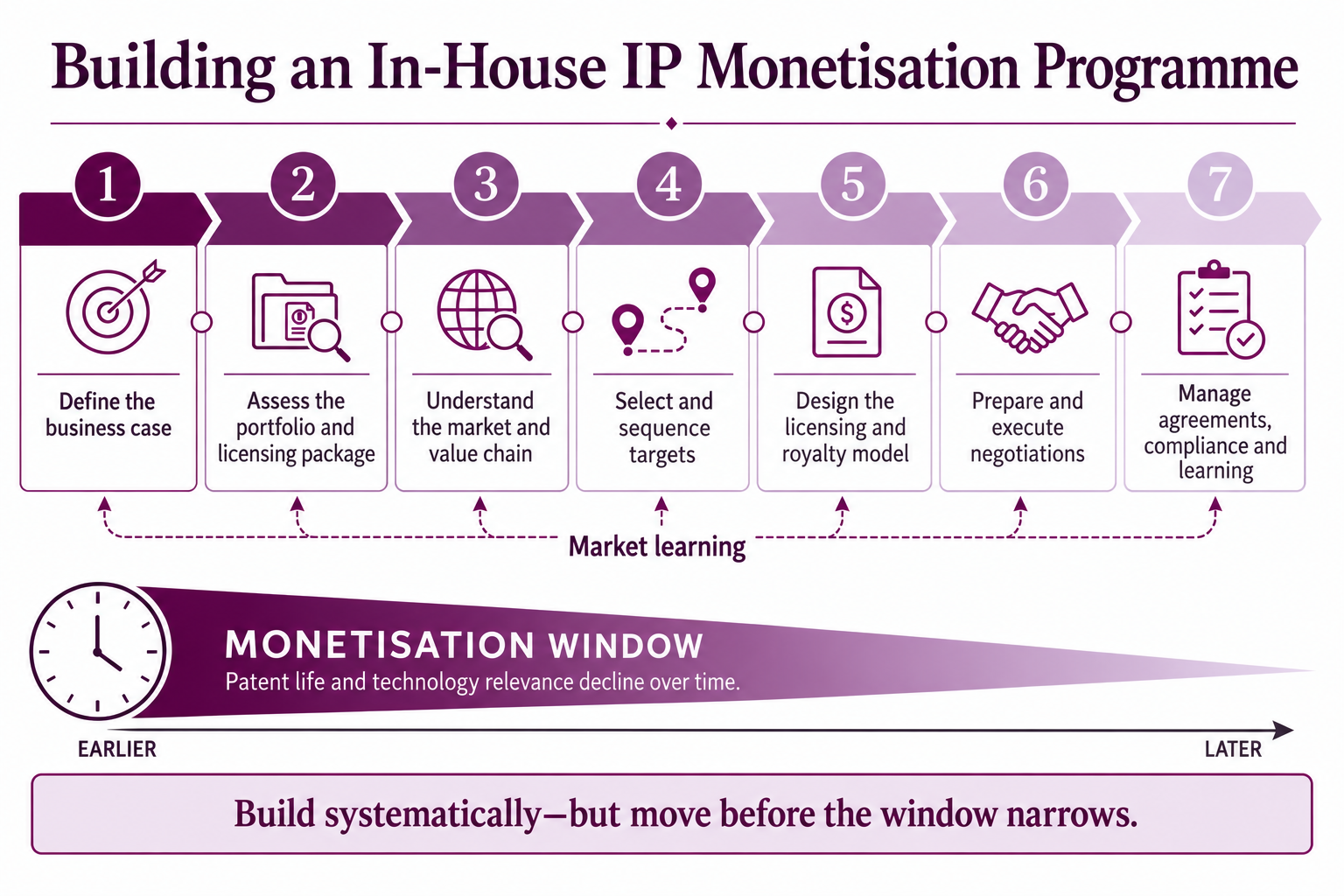
Figure 1: Building an in-house monetisation programme
Patent licensing and technology licensing start from different positions
Patent and tech licensing are often discussed together, but their commercial starting points are usually different.
In pure patent licensing, the potential licensee is already using the patented invention. The licensor’s task is to identify that use, explain the relevance of the patents, establish the value of the portfolio and negotiate a licence. If the parties cannot agree, patent enforcement may eventually be needed.
In tech licensing, the technology is often not yet in use by the potential licensee. The licensor needs to convince the other company to adopt the technology and build it into its products, manufacturing processes or services. The commercial discussion is therefore much closer to selling a technology solution. The value proposition, transferability of the technology, documentation, technical support, potential improvements made to the technology and the licensee’s own business case become especially important.
A useful high-level distinction is the following:
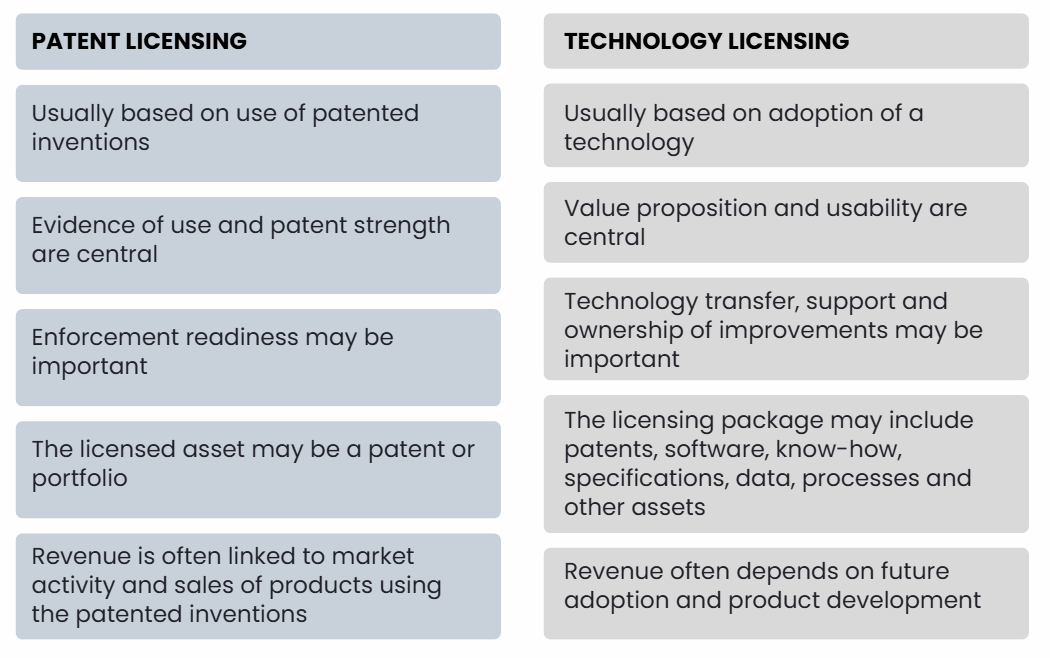
This distinction matters throughout the programme. It affects the business case, market analysis, target selection, commercial model, organisation and expected time to revenue.
Start with the business case and manage expectations early
The ambition behind licensing is compelling: to turn the company’s creativity and accumulated innovation into revenue without the capital and operational burden of sourcing, manufacturing, logistics or customer support. Licensing can provide a scalable route to growth, but realising that ambition will require disciplined investment in programme development and execution.
Before building an in-house monetisation programme, management needs a realistic business case. The basic questions are similar to other investment decisions. What is the opportunity? What investments are required to reach it? How long will it take? What are the risks? How can those risks be mitigated?
In patent licensing, the opportunity can often be estimated by looking at potentially infringing products, sales volumes, relevant geographies, expected royalty levels, the number of potential licensees and estimation of licensing success over a time period. A valuable patent portfolio does not automatically create a valuable monetisation programme. Commercial viability also depends on whether use of the patents can be demonstrated, relevant geographic coverage, remaining patent life, total licensing value of the intended licensees and the company’s willingness to enforce its rights.
In technology licensing, the calculation is different. The licensor needs to understand the value of the technology to the potential licensee, the size of the addressable market, likely adoption and the commercial structure that the market can carry. These calculations are never exact, but they are necessary. Management should have enough information to make an informed decision on whether the potential return justifies the required investment.
When presenting the business case, it is useful to separate different types of programme costs. Some costs relate to maintaining the licensing capability itself, such as the internal team, systems, analytics and portfolio management. Others are transaction costs connected with individual negotiations, external advisers and technical work. Enforcement costs are a separate category and can be significant when they arise. Separating these costs clarifies the programme’s baseline investment and the additional funding needed later when the programme matures.
Expectations about time to revenue are especially important. Time is always a strategic constraint: patents expire, technologies have a commercial shelf life and delays can materially reduce the monetisation window.
Licensing is usually a long-term business. The programme may require substantial preparation before the first serious negotiations even begin, and this assumes the technology or patents are existing and ready for licensing. Technical analysis, market research, target selection, go-to-market strategy, licensing materials, royalty modelling and internal approvals all take time. In patent licensing, the programme may also require investment in enforcement during its lifetime. In technology licensing, the market itself may need to be developed before the technology is widely adopted.
One problem I have seen is that management expects revenues before the programme has had enough time to mature. This can happen, for example, when a new patent licensing programme does not receive litigation resources because those resources are being used by more established programmes. The new programme is still expected to produce results, but one of the tools needed for its execution is missing.
Technology licensing may also have an expectation management issue, although in a different form. Management may believe that the market is ready to adopt a technology faster than it actually is. If the product-market fit is strong and customers are already asking for the solution, execution is easier. If demand still needs to be created, the licensor must invest in market creation as part of the programme.
In some industries, market creation happens through the value chain. Automotive is a good example. A technology licensor may need to create interest first with OEMs and brands, which then require their suppliers to provide the technology. The actual licensee may therefore be a tier 1 supplier, even though the demand originates from the OEM. Without understanding this dynamic, expectations on licensing speed can become unrealistic. By contrast, patent licensing of standardised technologies may bypass the supplier route with licensing taking place at the OEM level, although this approach took time to become established. This illustrates how patent licensing and technology licensing can work very differently within the same industry.
Know what you have before deciding how to monetise it
A monetisation programme should start with a good understanding of the portfolio. This sounds obvious, but larger companies can own thousands of patents without having an up-to-date commercial view of what the portfolio contains. Patent management and monetisation analysis are related, but they are not the same exercise.
For patent monetisation, the portfolio should be analysed from several perspectives:
What technologies do the patents cover?
Where are they valid and are the market relevant geographies covered?
How much lifetime is left and how does this fit to the relevant product lifecycle?
How strong are the claims and how difficult it is to prove infringement?
Are the inventions actually being used in the market and can you prove it?
What is maturity of the portfolio, are patents granted and alive?
Are some patents potentially standard essential and therefore better handled separately?
The portfolio should normally be clustered into relevant technology areas. From there, the company can start identifying which products and market players use the relevant technologies.
Patent analytics can be done internally or externally. An established licensing company may already have strong internal capabilities and use external experts mainly for additional analysis or a second opinion. A company entering licensing for the first time may need more external support.
AI has made portfolio analysis significantly faster, particularly for large portfolios, but this does not eliminate the need for human judgement. The questions asked from the data, the interpretation of technical concepts and the final commercial conclusions still require people who understand both the technology and the licensing objective.
Technology licensing requires a broader assessment. The company needs to identify the full package that makes the technology usable by somebody else. Patents and other IP and assets may be part of that package, but it may also include software; source code; object code; APIs; algorithms; design files and drawings; technical documentation; databases; testing methods; process data; specifications; manufacturing information; configuration parameters; know-how and training material; and so on.
The critical question is whether the technology can actually be transferred and used by the licensee. A technology may be technically excellent and well protected, but if it cannot be documented, transferred or supported in practice, it is difficult to build a scalable licensing business around it. The complexity increases further when the technology continues to develop and the parties need to decide who owns future improvements.
Understand the market and the value chain
After understanding the portfolio, the next step is market analysis. This should include market size, growth, technology adoption, major players, products, supply chains and value chains. The analysis needs to answer a practical question: where in the value chain is the commercial value created, and which companies are in the best position to pay for it?
The technically strongest target is not always the commercially best one.
In patent licensing, a company may have a technically strong infringement case against a relatively small market player. If the damages value is low, the case may not justify the transaction costs of licensing and enforcement. On the other hand, a large and financially attractive target may not be useful if infringement is difficult to prove, the relevant patents are weak or in case the licensor does not have realistic enforcement plan. Design-around possibilities also matter. If infringement relates to a feature that can easily be removed or changed, the economic value of the case may be much lower than the overall product sales suggest.
In technology licensing, value-chain analysis is equally important, but for different reasons. The licensor needs to identify who decides whether the technology is adopted, who implements it and who ultimately takes the licence.
Automotive again provides a useful example. OEMs often decide what technologies they want in their vehicles but expect tier 1 suppliers to obtain the necessary technology licences. A supplier may be reluctant to take a licence before it has won business from an OEM. At the same time, it may need access to the technology before it can credibly offer the solution to that OEM. The programme must therefore understand the timing of adoption, supply decisions and licence negotiations.
Target selection is also about sequencing. The largest infringer or company on the market is not necessarily the right first target. Early agreements can help test the royalty structure, create experience for the team and sometimes establish useful commercial or technical reference points for later negotiations. Starting with a particularly difficult target may consume significant management and enforcement resources and slow down the programme ramp-up. The order in which targets are approached should therefore be part of the licensing strategy.
This is why market value-chain research should come before target selection. Who uses the technology is important, but so are questions such as who benefits from it, who controls adoption, who can pay and who will actually sign the agreement.
Example: adding a new programme inside an established licensing business
One large licensor wanted to create a new licensing programme from a particular cluster of patents. The company already had good knowledge of its portfolio and could identify a large number of patents relevant to certain technologies. However, it wanted deeper analysis of the specific clusters and potential infringers, together with evidence of use. An external patent analytics company was contracted to support the work. At the same time, the company’s internal team analysed the relevant markets, major players, market size and possible royalty structures.
The licensing team then combined the technical and market analysis into the actual programme, prepared the business case, checked how it fitted with the company’s other businesses and prepared the required management approvals. Most of the execution remained internal, led by the licensing team, while external support was used for technical work. This division of responsibilities illustrates how external expertise can strengthen an in-house programme without transferring ownership of the business outside the company.
In another licensor company, the outsourced work also extended to market analysis while a third company outsourced almost everything except internal decision making and strategic leadership. These are a fairly typical examples of how external expertise can strengthen an in-house programme without transferring the overall ownership of the business outside the company.
Design the licensing proposition before approaching the market
Once the portfolio, market and targets are understood, the programme needs a clear licensing proposition.
For patent licensing, this normally includes a defined patent portfolio, selected claim charts or evidence of use, potentially technical explanations, an initial commercial proposal, an NDA position and a draft agreement, or at least a term sheet.
A licensor does not need to present every detail in the first contact, but it should be ready internally. Careful preparation before licensing discussions helps the licensor explain the infringement, portfolio value and commercial terms confidently making the negotiation process more efficient and focused.
Tech licensing requires a different type of proposition. The potential licensee needs to understand what the technology does, how it creates value, what investment licensee needs to adopt the technology and what support will be provided. The package may therefore include technical documentation, specifications, implementation support, technology transfer, training and other services alongside the IP licence. Technology licensing propositions typically also include a view on ownership of potential later improvements of the technology.
The commercial model should be designed based on the value of the technology and market conditions. There is no royalty structure that works for every programme. Royalty structures can be grouped into several categories:
use-based royalties, such as per-unit or percentage-of-sales royalties;
time-based royalties, such as annual payments or subscriptions;
other fee types, such as development, service or support fees; and
payment-timing structures that determine whether payments are made upfront, during development, at launch or after commercial sales begin.
Programme valuation estimates expected future income. The royalty model is separate: it structures the agreement to achieve that value in practice. Pricing is then affected by market practice, the licensee’s alternatives, portfolio strength, bargaining power, litigation risk, timing and the structure of the transaction.
The important point is that the licensor should have a preferred structure before negotiations start, but the programme should also learn from the market.
Example: changing the model after market feedback
In one technology licensing programme, potential licensees were interested in the technology but reluctant to sign agreements because of a relatively large upfront payment.
The original model included an upfront fee followed by running royalties once products using the technology entered the market. From the licensor’s perspective, the upfront payment was understandable because it would take time before product royalties started to flow.
From the licensees’ perspective, however, the model required a significant investment before they had any revenue from the new technology.
The solution was to change the commercial structure. The running royalty remained, but the large upfront payment was replaced with a lower recurring payment during the development phase. This payment was structured as a subscription giving access to the know-how required for product development. Consulting and development services were also provided against separate fees.
The revised structure lowered the initial barrier for the licensee while creating earlier recurring revenue for the licensor.
This is a good example of why licensing models should be market tested. A company may have a logical internal view of how the technology should be priced, but if the structure prevents adoption, the programme needs to adapt.
Build the organisation around the lifecycle of the programme
Licensing is cross-functional and data-intensive business. It typically requires technical, commercial, legal, financial and operational capabilities.
Instead of starting by drawing an organisation chart, it is useful to look at the programme in three phases: preparation, execution and post-signature management.
Programme preparation
During preparation, the company needs people who can understand the portfolio, technology, market, licensing and commercial opportunity. This may involve patent experts, engineers, market analysts, licensing professionals, legal and enforcement support as well as financial modelling.
A large organisation may already have many of these capabilities internally. A smaller company may have one internal programme owner who coordinates several external experts.
Programme execution
Execution requires licensing professionals who can explain the portfolio or technology, understand the legal and commercial environment and negotiate agreements.
The background of licensing executives varies. Some are engineers, lawyers and commercial professionals, and many have experience across several of these areas. There is no single correct profile.
Before negotiations begin, the programme should define who can approve royalty rates, settlement ranges, contract deviations and litigation expenditure. Although the licensing team may not have authority to make every decision, it needs an efficient process for obtaining approvals when required. This gives negotiators flexibility and speed while maintaining consistency across the programme.
In patent licensing, the team must be able to explain the infringement and the value of the portfolio, and understand the complexities of the enforcement environment. In technology licensing, the discussion may be much closer to technical sales and business development, involving engineers, product teams, purchasing organisations and commercial management.
Legal support, including potential enforcement support is important in both.
Post-signature management
After agreements are signed, another set of business capabilities becomes important.
Royalty report handling, invoicing, forecasting, compliance, contract management and royalty audits require structured processes. Technology licensing may additionally require tech transfer, technical support and continuing engineering and development activities. Poor post-signature compliance can destroy part of the value that was created during the licensing negotiation, which is why reporting requirements, audit rights and royalty structures should be designed together.
A common mistake is to focus heavily on negotiations and give too little attention to what happens after signing. The most important organisational point, however, is simpler. Someone inside the company needs to own the programme as a whole.
The company may outsource analytics, licensing negotiations, litigation, audits or other parts of execution, but there should still be an internal champion with the mandate to drive the business, make sure different pieces fit together and maintain the link with company strategy. Without that ownership, the activity easily becomes fragmented between IP, legal, finance, external advisers and business units.
Enforcement readiness is part of patent monetisation
Patent licensing requires a realistic view of enforcement.
It is sometimes said that there is no patent licensing without a credible threat of litigation. This statement should not be understood as meaning that litigation is the objective, but rather the patent owner must ultimately be prepared to use the legal rights on which the licensing programme is based. Most patent licences – especially in standardised technologies – are agreed through negotiations, but the programme needs to consider what happens when negotiations do not lead to an agreement.
In some non-SEP licensing cases, potential licensees may not engage seriously before litigation starts. This can happen even where the licensor has a credible portfolio, evidence of infringement and a well-prepared licensing offer. SEP licensing has its own dynamics. Negotiations may continue for years while licensees continue use of the technology without a licence, and enforcement takes place in a legal and commercial environment shaped by FRAND obligations and jurisdiction-specific case law. That topic deserves separate treatment, but the broader programme point remains the same: enforcement resources and strategy need to be considered as part of programme planning. The existence of a credible enforcement option can affect negotiation behaviour even when that option is never used.
Enforcement readiness should be viewed as a process of building and preserving the evidence needed if negotiations later move into a dispute. In patent licensing, this includes maintaining evidence of use at different levels of detail, from material suitable for licensing discussions to documentation that can support litigation. In technology licensing, comparable discipline is needed in documenting what technology or know-how was shared, when, with whom and under what confidentiality terms.
Enforcement also affects management expectations. If a new programme requires litigation but does not receive the necessary budget, the programme may develop more slowly. The expected revenue should reflect the tools the organisation is actually willing to provide.
Technology licensing usually has less need for patent enforcement at the beginning because the licensee is not yet using the technology. Enforcement becomes more relevant after the agreement is in place, for example in relation to payment obligations, confidentiality, misuse of know-how or use of the technology outside the licensed scope.
In both cases, the licensor needs to be willing and able to enforce both its IP rights and its agreements. That capability strengthens the credibility of the programme, supports compliance and helps the licensor protect and realise value over time.
Licensing needs to fit with the company’s other businesses
For many companies, licensing is an additional business rather than the core business. This creates both opportunities and conflicts.
A manufacturing company may have customers that are also potential licensees. Asking an existing customer to pay additional patent royalties can be commercially sensitive. If enforcement would be required, litigating against an important customer may simply be unacceptable.
This can limit the programme substantially. Sometimes patents are divested to a third party to avoid the problem, but even then, the sale may include restrictions or carve-outs preventing the buyer from asserting against certain existing customers.
Technology licensing can create a different dynamic. If the licensed technology brings additional value to the same customer, licensing may fit naturally alongside the existing product business relationship. The company may also find ways to combine royalty revenues with sales of components, services or technical support.
I have recently seen companies in several industries, including heavy machinery, telecommunications and chemistry, look more actively at this kind of additional monetisation. In most cases, this is not aggressive licensing. It is simply a question of identifying whether the company has know-how, technology or IP that customers would be willing to pay for separately.
Sometimes the main barrier is internal. A company has operated for years with a product-sales mindset and has never seriously considered whether part of its technology could also be licensed. In that case, an internal IP or licensing champion will be crucial in turning the idea into a real business initiative.
Example: licensing supporting product sales and an ecosystem
Technology licensing can create value beyond royalties.
In one recycling-related example, a company had process technology for combining new and recycled material to create a more sustainable end product. Licensing the process allowed the licensee to create a product with higher sustainability value and potentially earn a premium. At the same time, the process required components supplied by the licensor, so the licensing programme also supported component sales.
In another example, the licensed process enabled recycling of products incorporating the licensor’s technology. Licensing the process helped create an ecosystem in which products using the technology could be recycled, supporting wider market adoption.
These examples show why the business case for licensing should not always be limited to royalty revenue alone.
The agreement needs to be managed after signing
A signed licensing agreement creates an ongoing business relationship. The licensor needs to know whether royalties are being correctly reported, contractual obligations are being followed and changes in the licensee’s business affect the agreement.
Public market information can provide useful signals. For example, if publicly available information shows strong growth in the sales of licensed products but royalty reports remain flat, the situation deserves a closer look. Acquisitions can create similar questions. If a licensee acquires companies operating in the licensed field, product volumes may be expected to increase. If there is no corresponding change in reporting, the licensor needs to understand why.
Agreements may also contain payment triggers linked to acquisitions, divestments, new products, new geographies or other events. These events do not always automatically appear in royalty reports.
This is where modern data tools and AI can bring meaningful improvements. Contract data, royalty reporting, company information, market data and patent information can increasingly be analysed together. This can help identify anomalies and prioritise compliance work.
The human role remains critical. Someone needs to review the information, understand the contract and decide whether further investigation is warranted.
Audit programmes should also be considered from the beginning of licensing, even if audits only start once the programme has been operating for some time. The need for audit depends partly on the royalty model. Fixed lump-sum or recurring fixed payments may require less verification. Per-unit royalties and percentage-of-sales models require more active compliance monitoring. Audit clauses should therefore be designed together with the royalty structure. The cost and complexity of future audits are part of the transaction costs of the programme.
Audits should also be treated as normal compliance work rather than an accusation against the licensee. A mature licensing programme checks whether it is being paid correctly just as any other business monitors its receivables and contractual performance.
In-house does not mean everything needs to be done internally
Building an in-house programme does not require the company to employ every capability itself. Portfolio analytics and market research can be outsourced. External counsel can handle litigation. Audits are normally carried out by third-party auditors. External licensing professionals can support negotiations. Patent pools can handle licensing for specific portfolios.
The important distinction is between business ownership and execution. A company should retain enough internal understanding to know why the programme exists, what commercial result it is seeking, how its assets are being used and whether the selected monetisation model remains aligned with company strategy.
Different monetisation routes have different trade-offs. Direct licensing allows the patent owner to retain more of the financial upside but also requires the company to carry the costs, organisation and risks of the programme.
Patent pools can offer efficiency and broad market coverage, particularly for standard-essential patents, but the licensor shares value and gives up some control over execution.
A licensing or monetisation agent can provide capabilities that the patent owner does not have internally. In exchange, the owner gives up part of the future revenues. Selling patents may transfer much of the execution risk and cost to somebody else. Again, the seller gives up part of the upside.
None of these models is automatically better than the others.
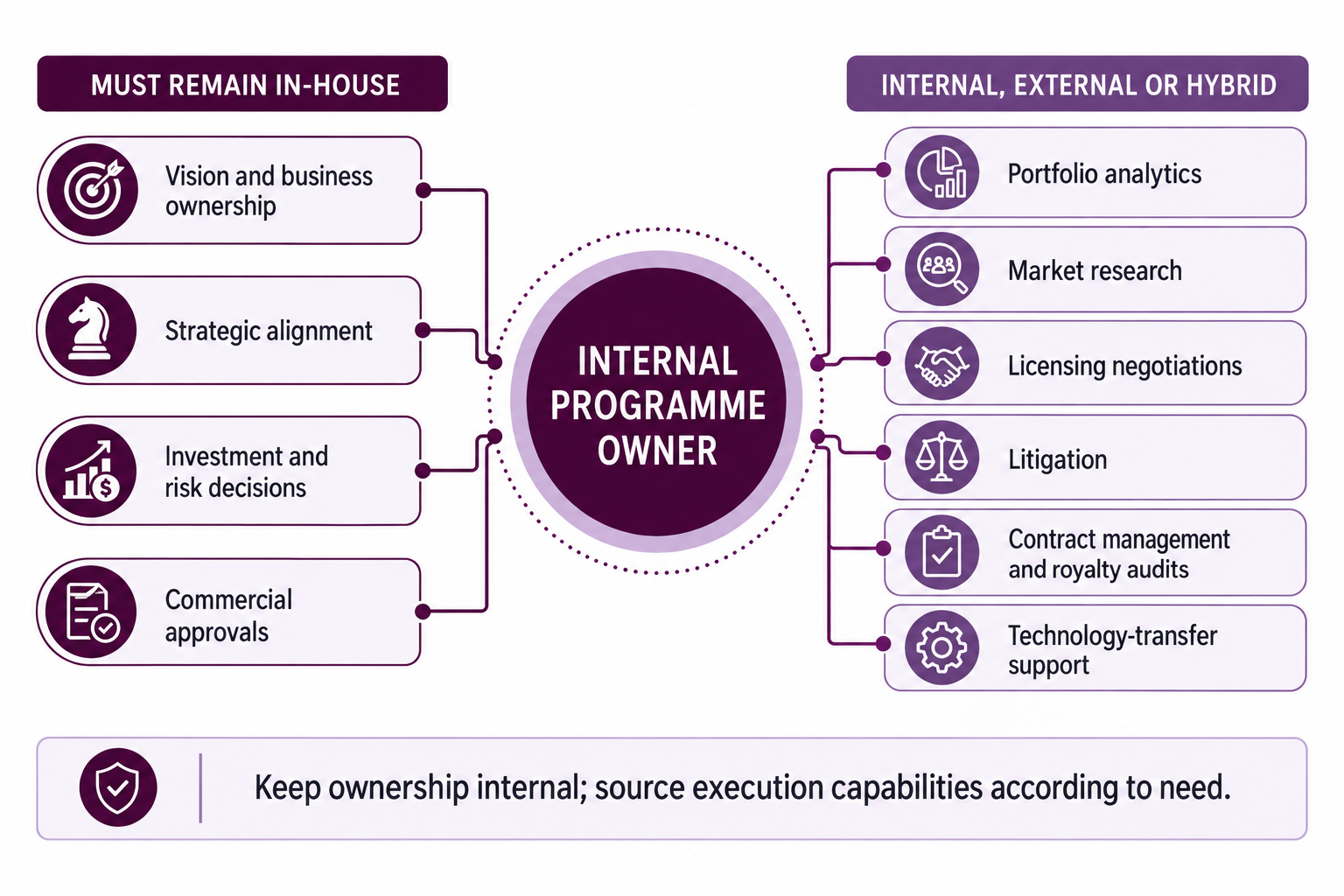
Figure 2: Internal Ownership
Example: a large company without licensing capabilities
One large patent owner had substantial manufacturing and service businesses but no established licensing operation. Its internal IP team was relatively small and did not have deep licensing experience.
The company used external analytics and advisory support to analyse the patent portfolio and identify possible technology clusters and monetisation programmes. Potential SEPs were separated for their own analysis.
Several approaches were considered. The company could build programmes around technology clusters, focus on specific major technology users, use external licensing support or sell parts of the portfolio. Because the internal IP team was small, external support was also used for licensing and potential patent sales.
This is a useful reminder that company size alone does not determine whether licensing should be internal. A large corporation may still have a small IP function and limited licensing experience.
Example: an SME choosing not to build its own programme
In another case, a small company had patents that appeared to be used by a relatively concentrated group of potential licensees. The monetisation opportunity existed, but the company did not have the resources or capabilities to run licensing negotiations itself, let alone to build and manage a full licensing programme.
The company sold the patents to a licensing entity that took responsibility for monetisation. The licensing entity received a share of the proceeds, while the original patent owner retained a revenue share. The company gave up a part of the potential upside, but it also avoided building a licensing organisation and carrying the execution and enforcement risk.
For that company, this was a rational business decision.
Why programmes underperform
There are many reasons why a licensing programme may not reach its expectations. Sometimes the underlying asset is the problem.
In tech licensing, the technology may simply not provide enough value or it may have lost its value over time. If the technology does not make the licensee’s product better, cheaper, faster to develop or more attractive to customers, licensing will be difficult. In patent licensing, the portfolio may be weaker than expected, geographically limited, easy to design around or simply not used in products with sufficient economic value.
Sometimes the problem is market selection. The company may target the wrong level of the value chain or focus on technically interesting targets with limited commercial value.
Sometimes the pricing or commercial structure does not work. Royalty expectations may be too high for the market, or the payment structure may require investment at a stage where licensees are not ready to pay.
Execution can also fail. The team may lack the right mix of technical, commercial and legal skills. Budgets may be too small. The company may be unwilling to fund travel to markets where face-to-face negotiations are important. Enforcement resources may not be available.
Internal organisation can also slow down the programme. Conflicting objectives between the licensing business and product business need to be resolved by management. The team needs a clear mandate and realistic incentives.
Finally, expectations about the time to revenue may underestimate how long it takes for a licensing programme to ramp up.
Portfolio creation takes years. Licensing programmes also take time to prepare, execute and scale. Enforcement may delay licensing efforts. Management should expect results and accountability, but it should also understand the investment period required to build the revenue stream.
A mature programme needs an overall view
For many companies, licensing starts with individual opportunities. A patent is found to be infringed. A technology receives interest from a potential partner. A non-core portfolio is identified. One agreement leads to another, and there is nothing wrong with starting this way.
However, looking into a programmatic way of licensing is becoming increasingly popular across industries, especially when there is pressure to create new revenue from IP investment.
As programmes mature, they need to keep developing with the market, technology and commercial lessons learned along the way. Information from negotiations should feed back into portfolio development. Market analysis should influence which technologies are protected. Licensing discussions should improve understanding of what customers value. Royalty reporting and audits should improve future agreement structures. Enforcement experience should affect future target selection and risk assessment. More specifically, licensing feedback on patent strength, design-arounds, portfolio gaps and licensee requirements should guide future R&D, patent filing and portfolio investment decisions.
As programmes mature, management should look beyond signed revenue and manage licensing as a business process that continues to learn from the market, negotiations, compliance work and technology development. The organisation and level of outsourcing may vary, but overall business responsibility should remain inside the company. This ensures that someone connects the portfolio, market opportunity, risks, external partners and wider company strategy and keeps the programme moving.
An in-house patent monetisation programme works best when the company treats it as a business with a defined opportunity, appropriate investment, realistic expectations and clear ownership. Technology licensing provides a useful additional lens because it makes the commercial side of licensing especially visible. It reminds us that successful monetisation depends on much more than the legal asset itself. It depends on understanding where value is created, who benefits from it and how the company can organise itself to capture a reasonable share of that value.