IPR MEANS BUSINESS | PART 1 OF 15
IPR Means Business by Sonja London is a 15-part series for business leaders, IP professionals and anyone asked to create, review or implement an IP strategy. It translates the core building blocks of IP strategy into practical business decisions.
Across four themes, the series examines how intellectual property can be used strategically, what an IP strategy should contain, twelve areas that require deliberate choices and how the strategy can be created and implemented as a continuing process. The aim is to make IP strategy useful in everyday management, not to produce a document that is never used in the business.
This first article focuses on the strategic models available to a company. Intellectual property is part of a company’s valuable asset base, but its value does not come from being locked away. It becomes valuable when it is used deliberately to support business objectives.
Start with the business outcome
A useful IP strategy begins by defining what the company wants its intellectual assets to achieve. The answer may be direct revenue, stronger margins, lower licensing costs or freedom to operate. A company may pursue several of these outcomes at the same time, but it should be able to explain the role each part of its portfolio is expected to play.
The model developed by Ruud Peters, formerly the long-serving head of IP at Philips, provides a practical framework. It places four strategic models against two dimensions: the company’s relative IP strength and whether the priority is profit growth or cost savings.
Four strategic models for using IP in business
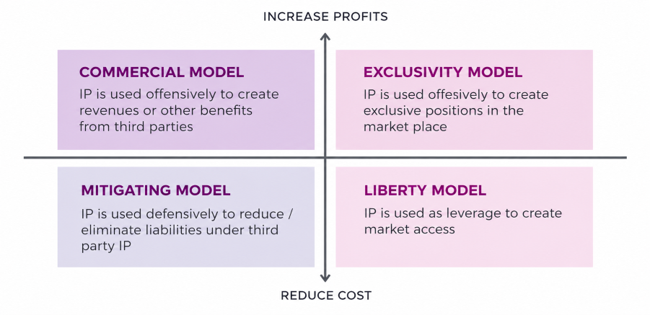
Source framework: Ruud Peters, Value Driven IP Management (2018). Published with his permission.
1. The commercial model: turn IP into direct financial return
The commercial model uses a strong IP position to generate income. The most visible route is licensing, but value can also be created through sale of IP, settlements and grant-back arrangements in which the company gains rights to improvements or related technology developed by the licensee.
This model is particularly relevant when a company owns IP that it does not use itself, or when a technology developer does not intend to manufacture products. It can also complement a product business. A company may reserve its core technology for its own products while licensing a feature, a separate application or rights for markets it does not plan to serve directly.
The central question is whether the IP can support a credible commercial proposition. Ownership alone is not enough. The rights must relate to technology or other assets that another party needs and is willing to pay to use.
2. The exclusivity model: protect margins and market position
In the exclusivity model, IP is used to strengthen the company’s competitive position. The aim may be exclusivity for a feature, a product category or an entire market position. Strong rights can make imitation more difficult, support differentiation and protect higher product margins.
This is the most familiar model for companies that develop and sell their own products, whether manufacturing is handled internally or through a supply chain. It does not mean that every right must remain exclusive. A product company may still use the commercial, mitigating and defensive models where they support the wider business strategy.
Exclusivity model should therefore be used selectively. The company needs to identify which elements genuinely create competitive advantage through exclusivity, and which could produce more value through broader use or licensing.
3. The mitigating model: reduce IP-related cost and exposure
The mitigating model focuses on cost reduction and risk management, particularly where the company’s relative IP position is weaker. It may include cross-licensing, royalty offsets and measures designed to prevent or reduce claims against the business.
This model should not be seen as an alternative to revenue generation or exclusivity models. It is often used alongside them. A company can use some rights to protect products, others to create licensing income and the portfolio as a whole to improve its position when third parties make demands.
Effective IP mitigation requires a detailed understanding of the company’s operating model, the technologies used in its products and the competitive IP landscape. Without that understanding, it is difficult to assess which rights provide genuine negotiating value or where licensing exposure may arise.
4. The defensive model: secure freedom to operate
The defensive model is centered on freedom to operate. The objective is to ensure that the company can continue operating in its chosen markets without avoidable disruption from IP disputes or exclusionary positions held by others.
Practical measures may include coexistence settlements, non-assert arrangements and agreements that keep both parties from using rights against each other. The model also covers defensive actions to prevent a competitor from obtaining an exclusive position that could restrict the company’s activities.
A defensive strategy is not the same as passivity. It requires preparation, a clear understanding of the relevant rights and the ability to respond when claims arise. Used well, this model protects continuity while controlling the cost of disputes.
The fifth effect: strategic leverage
On top of this framework we also need to recognise an indirect form of strategic leverage. In this role, IP supports wider business aims even when the immediate result is not a licence fee, higher margin or cost saving. The value may appear for example through a stronger position in merger or business divestment negotiations or through more credible options in building a commercial ecosystem.
Strategic leverage is best understood as an indirect effect that can impact across the four models rather than be a separate box in the picture. It is a reminder that IP can influence business outcomes in ways that are not always visible in the IP budget.
Your business model determines the right combination
These IP models work differently in different businesses. A technology licensor, an industrial manufacturer and a software service company will not use IP in the same way. Even companies in the same sector may choose different combinations depending on their market position, resources and risk tolerance.
A useful management discussion should address at least these questions:
Where should IP create direct revenue?
Which products, features or markets require exclusivity position?
Which licensing costs and claims should the portfolio help reduce?
What freedom to operate must be secured for the business plan to succeed?
What kind of indirect leverage the portfolio can create for the relevant ecosystems, supply chains and competitive position?
The answers provide the bridge from general ambition to a successful IP strategy. The strategy should define both the objective, meaning why IP matters to the company, and the methods of how the portfolio will be used to achieve that objective.
IP protection is not the strategy
Protection is one part of IP management, but it is not the final purpose of IP strategy. A portfolio can support revenue growth, cost control, competitive advantage and collaboration. The strategic task is to choose the role of each IP asset and to align those choices with the business model.
The first step is therefore not necessarily to file for more IP rights. It is to decide what the company expects its intellectual assets to achieve. Once that is clear, protection, licensing, portfolio management and enforcement can be designed around a defined business purpose.